A Gym in Nashik Gives an Ad More Time Than Any Billboard
A billboard gets 3 seconds in Nashik, a gym screen gets a full workout. See what drives gym ad pricing, timing, and how founders test it first.
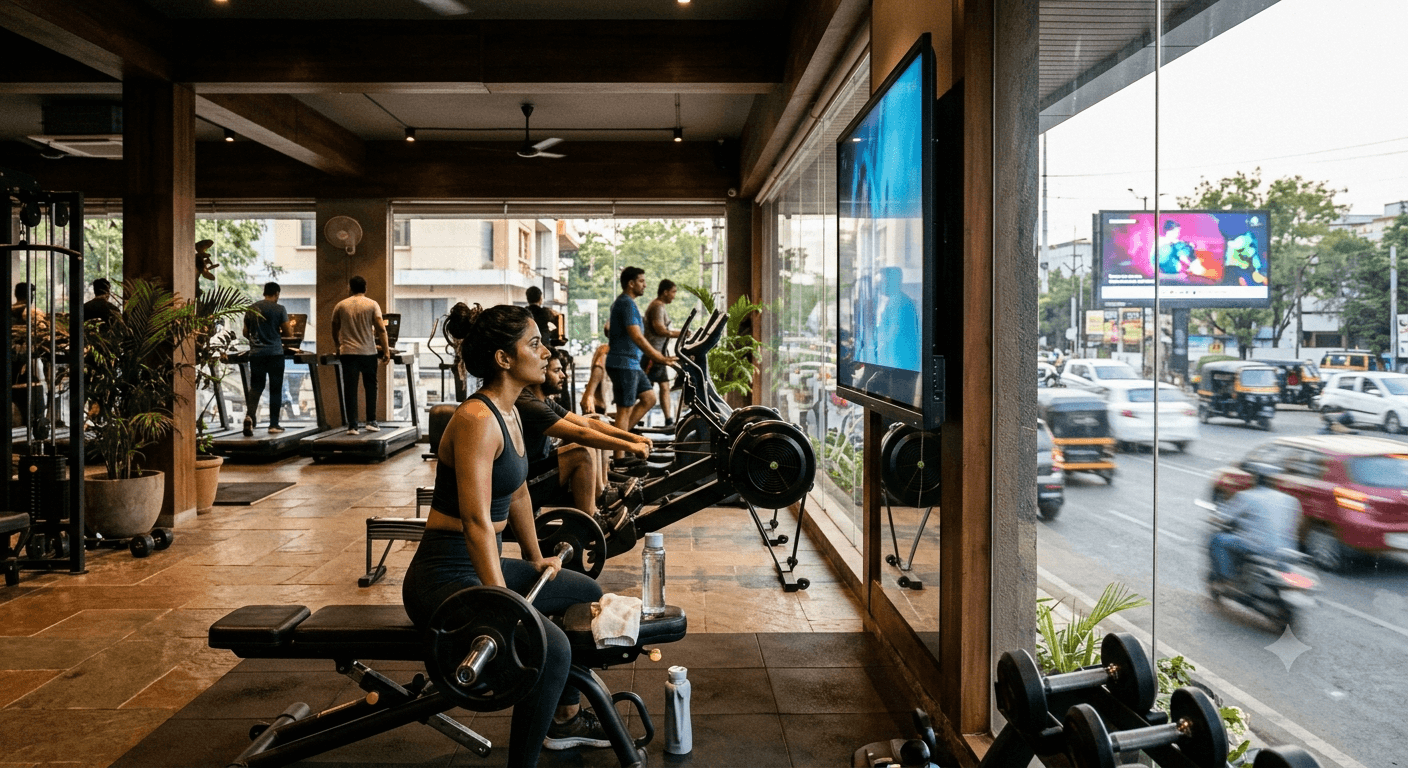
A billboard on Gangapur Road gets seen for 2 to 3 seconds from a car in motion. A gym screen in the same city gets seen for 64 minutes, the length of an average workout. No other indoor space in Nashik holds a member's focus this long, yet few founders in the city book this format.
The Screen Stays in View Through Every Rest Between Sets
That stretch of focus is not one long stare, it breaks into short glances repeated many times over. A member enters a gym, warms up, works through a set, rests, then works through the next set, and a screen on the wall sits in view through each pause. A member sees the same screen 10 to 12 times in one session this way, since the member stays in the room between sets instead of walking away like a driver passing a billboard.
That repeat pattern is the reason XLAR places screens inside gyms across Nashik as a separate category from its clinic and retail screens. A gym member looks at a screen far more times per visit than a patient or a shopper does, so a gym campaign needs its own pricing and its own creative approach, not the same plan used for a waiting room or a supermarket aisle.
This repeat pattern pays off only if the pool of gyms and members grows. In Nashik, that pool grows now.
Nashik Adds Gyms at the Same Pace as the Rest of India
India's fitness membership base moves from 12.3 million to 23.3 million by 2030, a growth rate of 11% a year, and this growth moves past Mumbai, Delhi, and Bengaluru into smaller cities. Talwalkars alone adds 50 centres aimed at those markets, and Nashik sits on that list. Local search terms confirm the same shift.
"Gym in Nashik," "best gym in Nashik," and "gym in Nashik Gangapur Road" carry steady monthly search volume, proof of live demand rather than a passing spike. Each gym that opens on College Road, in Ambad, or in Panchavati adds a wall, a screen, and a fresh set of members.
More gyms raise the number of members a screen can reach. Not every gym in the city charges the same rate for that reach.
Membership Profile Sets the Price, Not the Building
Two gyms of equal size can carry two different rates, because price tracks the member base, not the floor plan. 65% of gym members in India fall under age 35, and this group spends ₹15,000 to ₹25,000 a year on membership fees alone. A gym on Gangapur Road or College Road, built around this member base, carries a rate apart from a gym in Ambad-Satpur MIDC, where working professionals fit sessions around a shift. Time of day changes the rate too.
Gyms run on 2 rush windows, 1 in early morning, 1 in evening, while a clinic or supermarket sees footfall spread across the whole day. A slot inside a gym's rush window costs more, since it reaches more members. A member walks through the room rather than stays in one spot, so a short video loop outperforms a static image here, the reverse of a waiting room, where a member stays seated with a page in hand.
None of this tells a founder with a fixed budget which single gym to start with.
Camera Counts Confirm Who Saw the Ad, Not Just Who Walked Past
A screen that runs on schedule still leaves one gap: a play log proves the ad appeared, not that a member looked at it. Camera-based counters close that gap. A small camera near the screen logs each member whose gaze passes across it, and that log gives a founder a real number instead of an estimate built on member totals alone.
Two gyms with the same 300-member base can produce very different counts depending on screen placement, machine layout, and how long members linger near a given wall.
XLAR's screens across Nashik use this method, so a report shows verified views rather than a schedule confirmation. For a founder comparing two gyms with similar rent-driven prices, this count is the number that actually decides which gym earns the budget.
One Gym Test Beats a Guess Across the City
A supplement brand fits a gym in Indira Nagar, where membership spend already sits at the high end, proof that members already pay for fitness-adjacent products.
A physiotherapy clinic fits better near Mahatma Nagar, where recovery and injury-related searches already run above the city average, proof that the audience arrives primed before the ad plays. A first test should run for 2 to 4 weeks in 1 gym before a second gym enters the plan.
Week 1 sets the baseline count. Week 2 through 4 shows whether that count holds steady, rises, or drops as the creative repeats. A founder should ask the gym or XLAR for the camera-based count at the end of each week, not just proof that the ad ran on schedule. XLAR's case studies list the steps other Nashik brands took for a first test, and the changes made once the numbers came back.
Nashik Gym Ad Slots Cost Less Before More Founders Notice
Nashik added new gyms and new members through 2025 and 2026, and each gym that opens brings new screen space with it. That space costs less now because few founders in Nashik have booked it yet. Once more brands test the format and see results, gyms with strong footfall will raise their rates, the same way any limited slot gets pricier once demand for it rises.
A billboard on Gangapur Road will still get 2 to 3 seconds from a passing car next year. A gym screen booked now locks in 64 minutes of focus at a price that will not last. Contact XLAR Media to book a first gym campaign in Nashik before that happens.
Anushka Wadsal
Published on 18 July 2026
Stay ahead of the curve
Join 5,000+ marketers getting our weekly DOOH insights.